My brain hurts. It's about to explode. My mind is going 10 million miles per hour and it won't stop.
I am at an amazing autism workshop this week and the amount of information is absolutely unbelievable! I wonder how I got through my undergrad and graduate programs without learning all of these great strategies and techniques! Actually, the fact is that I already knew a lot of this stuff, but hearing it from new people has given me a new prospective.
I could honestly go on for hours about everything I am learning, but the truth of the matter is that I can't implement it all right away. There is not enough time in the day and its unrealistic to turn my classroom into a new program with less than three months left. I have begun to prioritize the projects I am going to implement as soon as I get back. Then, this summer I can focus on setting up everything for the fall.
Priority #1: Create Areas in my Classroom
Students with autism are very visual learners. They are also very unorganized by nature, so it is important to create different spaces that they can relate certain tasks or activities with and to help them organize their tasks. In my classroom these seems completely unrealistic. I have 2 horse shoe shaped tables that are used for many purposes including snack, centers, art, and 1 on 1 work. The important part is to differentiate the tasks so that students don't get confused. I didn't think that this was a problem in my classroom until I really began to think about my little non-verbal guy with autism. Every time we go towards the tables he pulls out his goldfish snack card. Is it possible he isn't always hungry? Is it possible he only associates those tables with snack time and not work time? The first think I am going to do when I get back to my classroom is create place mats specifically for snack time. This way, the students can associate the table AND the place mats as snack time. I am also going to consistently use a blue table cloth on the table during art projects to help the students associate that it is time for art. The rest of my room seems to be set up pretty nicely. I have a free explore area, a books & puzzles area, and a circle time area.
Priority #2: Circle Time Signals
Students with autism have a difficult time processing language and learn much better from visual cues. Often times during circle time I have students shouting out with they should be thinking or starting off topic conversations. I also have a difficult time with my general education students shouting out answers without giving my lower students wait time. I often pair a verbal prompt such as "turn on your listening ears" with a motion, but not all of the students get it. I am going to create signs for circle time to prompt students to listen, think, and talk. For "listen", used during story time or directions, I will have a picture of a giant ear. For "think", I am going to have a picture of a student "tapping his thinker", and for "talk" I am going to use a picture of a student raising his hand. Hopefully this will be a quick success and help with classroom management!
Priority #3: Communication Corner
This workshop has focused a lot on student schedules and using those as the first step in communication. I do use a picture schedule with my students, but some of them are not at that abstract level yet and really need an object schedule. I would like to work on creating a "Communication Corner" where student's schedules can be placed and a collection of objects, photographs, and picture symbols can be kept for choice making opportunities and transitioning students from one activity to another. This project will take a while to create a set up, but I feel it is important to begin this now, so that my students have more opportunities to appropriately communicate.
I will be sure to keep you updated on my progress with these 3 projects : )
Showing posts with label Picture Schedules. Show all posts
Showing posts with label Picture Schedules. Show all posts
Thursday, February 16, 2012

Monday, December 5, 2011
A Word from the Wise
Throughout both my undergrad and graduate years, professors often times held panels with teachers. A common panel question was "What advise to you have for future teachers?" Without fail, everyone always mentioned something about classroom management, routines, and behavior management plans.
For me, this has been one on the most important aspects of my classroom, even more so than other teachers, because my classroom is so different than most. First off, my students are little. Children can start attending our preschool at 2 years, 9 months. With kids that little it is important to have clear rules and expectations as soon as they walk in the door. My classroom is the very first experience these children have had in a classroom, so that means I have to teach them how to sit at circle, raise their hands, stand in line, and clean up their activities.
Another unique part of my classroom is that I get new students all the time. My small caseload of 8 students at the beginning of the school year has grown into 25, just 4 short months later. As a special education teacher, there are three ways a student can start in my classroom. First, if a child receives services from DDD (Department of Developmental Disability) they transition into my program before their third birthday. Second, if a parent notices a delay in their child, they can bring them in for our Child Find program. If the student qualifies for services they start shortly after their evaluation takes place. The third way a student can enter my classroom is if they have an Individualized Education Plan (IEP) from another school district, and they have moved into our district. This means I get new students all the time and sometimes I don't know when they are coming. It has been very important for me to have a strong classroom management system, so that when a new student come in the transition is easier and the expectations are clear.
Literature is always a great way to talk about behaviors with kids. "The Recess Queen" by Alexis O'Neill is one of my favorites. This book is a great way to introduce students to appropriate behaviors and peer interactions. The students love this book and we ended up reading it 3 times during circle time. I was also able to incorporate some fun centers that were based on the book. The most popular centers were action word flash cards using words from the book, an indoor obstacle course, and a sensory table full of sand and small manipulative for a "mini playground".

My picture schedule (made with Board Maker and velcro) has been one of the greatest management tools in my classroom. At the beginning of the year I always had students ask "outside?" or "playground, please?". With this amazing and simple picture schedule the students know exactly what comes next and there are no surprises. At the beginning of the class we go through the schedule together and as we complete activities the students move the pictures over to "finished" side. This has been a great help with transitioning students to therapists throughout the day. I also have an envelope with extra pictures for not-so-common activities, such as if a visitor is coming in or indoor games for rainy days. So, even if the routine changes a little, the students still have plenty of opportunities to prepare for the change.


I never thought that washing hands would be such a big ordeal in preschool. If anything, I thought I would have a difficult time getting my students to wash their hands. In reality, all of my students want to wash their hands, all of the time. If one student goes to wash his hands, all of the students suddenly "need" to wash their hands too. This is great for keeping my classroom germ free, but it was becoming such a distraction. So, enter the "Wash Hands" ticket. I traced a kids hand, cut out a ton of hands, wrote "wash hands" on each one, and had them laminated. Now, students can not wash their hands without a ticket. If they are given a ticket, they take it to the black basket next to the sink and wash their hands. This has also been great for keeping the kids from piling up near the sink area. I can control how many students are at the sink at a time and how often they are washing their hands.


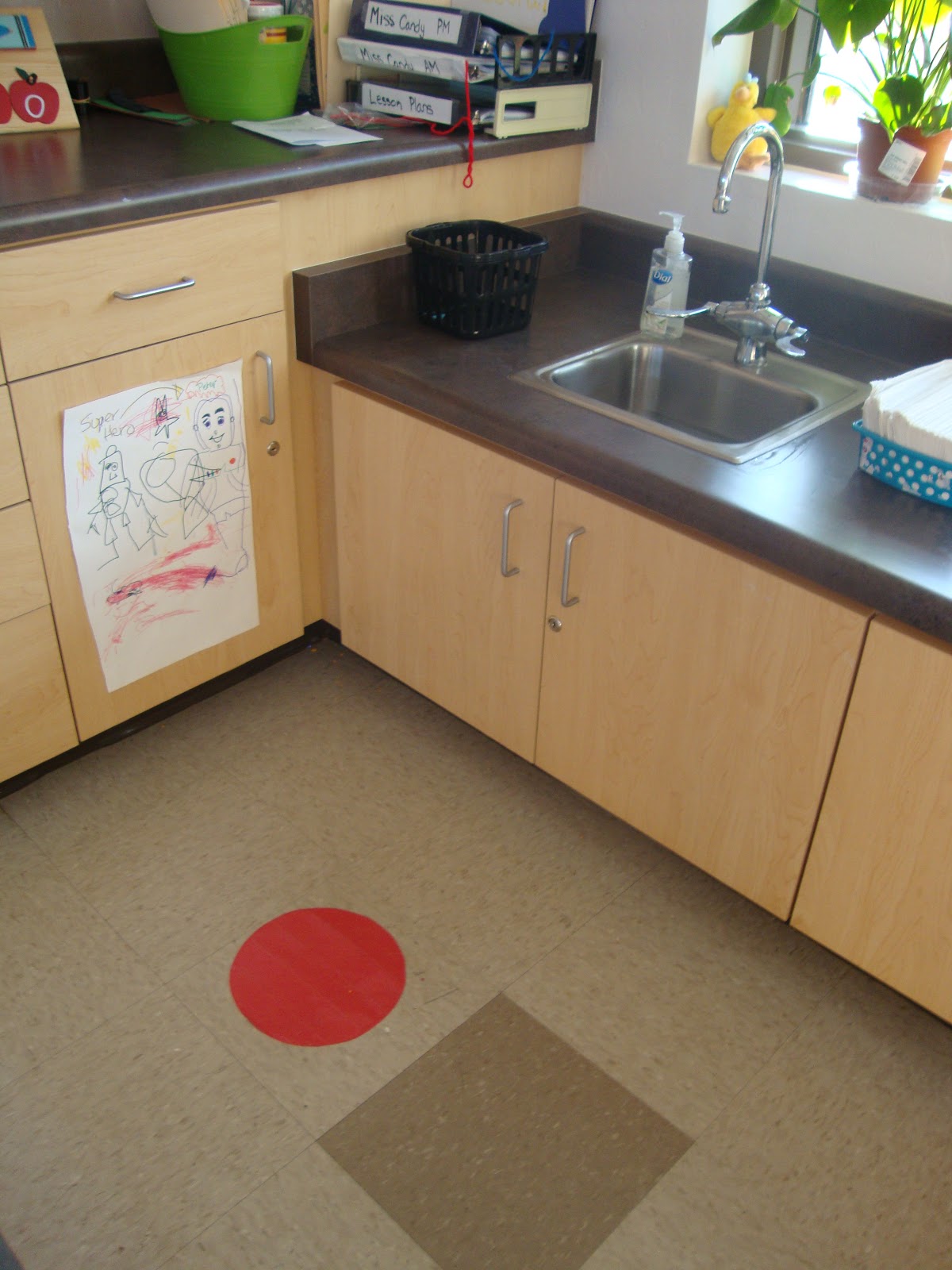
"The Red Dot" has become a life saver for helping my kids to line up. Little ones always seem to start their lines in the most odd places. They are either so close to the door that they could get seriously hurt if the door was opened or are 20 feet away from the door. 3 Red Dots are on my floor, helping my students to line up without being in the way. Their is one leading to the playground, one leading to the classroom next door, and one at the sink.
This has also been an amazing tool for one of my more severe students who also happens to be non-verbal. Before, when he wanted to go outside, he would run. He would run as fast as he could, usually slamming the door in my face. Now, I have taught him that if he is ready to go outside he needs to stand on the red dot and wait for me to walk with him. So far, it has been a great way for him to communicate to me that he is ready in a more appropriate way.


For me, this has been one on the most important aspects of my classroom, even more so than other teachers, because my classroom is so different than most. First off, my students are little. Children can start attending our preschool at 2 years, 9 months. With kids that little it is important to have clear rules and expectations as soon as they walk in the door. My classroom is the very first experience these children have had in a classroom, so that means I have to teach them how to sit at circle, raise their hands, stand in line, and clean up their activities.
Another unique part of my classroom is that I get new students all the time. My small caseload of 8 students at the beginning of the school year has grown into 25, just 4 short months later. As a special education teacher, there are three ways a student can start in my classroom. First, if a child receives services from DDD (Department of Developmental Disability) they transition into my program before their third birthday. Second, if a parent notices a delay in their child, they can bring them in for our Child Find program. If the student qualifies for services they start shortly after their evaluation takes place. The third way a student can enter my classroom is if they have an Individualized Education Plan (IEP) from another school district, and they have moved into our district. This means I get new students all the time and sometimes I don't know when they are coming. It has been very important for me to have a strong classroom management system, so that when a new student come in the transition is easier and the expectations are clear.
Literature is always a great way to talk about behaviors with kids. "The Recess Queen" by Alexis O'Neill is one of my favorites. This book is a great way to introduce students to appropriate behaviors and peer interactions. The students love this book and we ended up reading it 3 times during circle time. I was also able to incorporate some fun centers that were based on the book. The most popular centers were action word flash cards using words from the book, an indoor obstacle course, and a sensory table full of sand and small manipulative for a "mini playground".

My picture schedule (made with Board Maker and velcro) has been one of the greatest management tools in my classroom. At the beginning of the year I always had students ask "outside?" or "playground, please?". With this amazing and simple picture schedule the students know exactly what comes next and there are no surprises. At the beginning of the class we go through the schedule together and as we complete activities the students move the pictures over to "finished" side. This has been a great help with transitioning students to therapists throughout the day. I also have an envelope with extra pictures for not-so-common activities, such as if a visitor is coming in or indoor games for rainy days. So, even if the routine changes a little, the students still have plenty of opportunities to prepare for the change.


I never thought that washing hands would be such a big ordeal in preschool. If anything, I thought I would have a difficult time getting my students to wash their hands. In reality, all of my students want to wash their hands, all of the time. If one student goes to wash his hands, all of the students suddenly "need" to wash their hands too. This is great for keeping my classroom germ free, but it was becoming such a distraction. So, enter the "Wash Hands" ticket. I traced a kids hand, cut out a ton of hands, wrote "wash hands" on each one, and had them laminated. Now, students can not wash their hands without a ticket. If they are given a ticket, they take it to the black basket next to the sink and wash their hands. This has also been great for keeping the kids from piling up near the sink area. I can control how many students are at the sink at a time and how often they are washing their hands.


"The Red Dot" has become a life saver for helping my kids to line up. Little ones always seem to start their lines in the most odd places. They are either so close to the door that they could get seriously hurt if the door was opened or are 20 feet away from the door. 3 Red Dots are on my floor, helping my students to line up without being in the way. Their is one leading to the playground, one leading to the classroom next door, and one at the sink.
This has also been an amazing tool for one of my more severe students who also happens to be non-verbal. Before, when he wanted to go outside, he would run. He would run as fast as he could, usually slamming the door in my face. Now, I have taught him that if he is ready to go outside he needs to stand on the red dot and wait for me to walk with him. So far, it has been a great way for him to communicate to me that he is ready in a more appropriate way.

Subscribe to:
Posts (Atom)